Hospitality & Business
Experiential Education
Students
Experiential Education
Hospitality & Business
Students Gain Real-World Experience at NYC Finance Forum
For Oscar Peña ’29 and Melody Baez ’28, attending the Global Asset Management Education (GAME) Forum in New York City wasn’t just a conference trip — it was a firsthand look at the industry they’re working towards.
The two Finance majors traveled to New York City with eight fellow members of JWU’s Wildcat Investment & Finance Initiative (WIFI) Club, a student-run organization that manages a real investment fund that is part of JWU’s endowment. Peña serves as vice president of WIFI, Baez as portfolio manager of WIFI. Here, they reflect on their experience at the GAME Forum, the largest student-run financial conference in the world hosted by Quinnipiac University. The Forum offers students opportunities for discussions and debates about financial best practices with world-renowned industry leaders.
From Campus to the Big Apple: Students Explore and Network in the City’s Finance District
On the first day of our trip, we started out early in Providence and caught the morning train to New York City. Even with the early wake‑up, there was a sense of excitement knowing what the next few days would bring. We arrived in Manhattan around 12:30pm, checked into our hotel and registered for the GAME Forum. After a short break to settle in, we regrouped for one of the most anticipated opportunities of the trip: a visit to Cerity Partners, an independent wealth management firm.
We met with members of Cerity Partners’ New York team and discussed current market trends, wealth management strategies and their ongoing relationship with JWU as a client. This experience was especially meaningful for the WIFI Club members and wouldn’t have been possible without the coordination and support of our club advisor, Diane Cunha, assistant university controller.
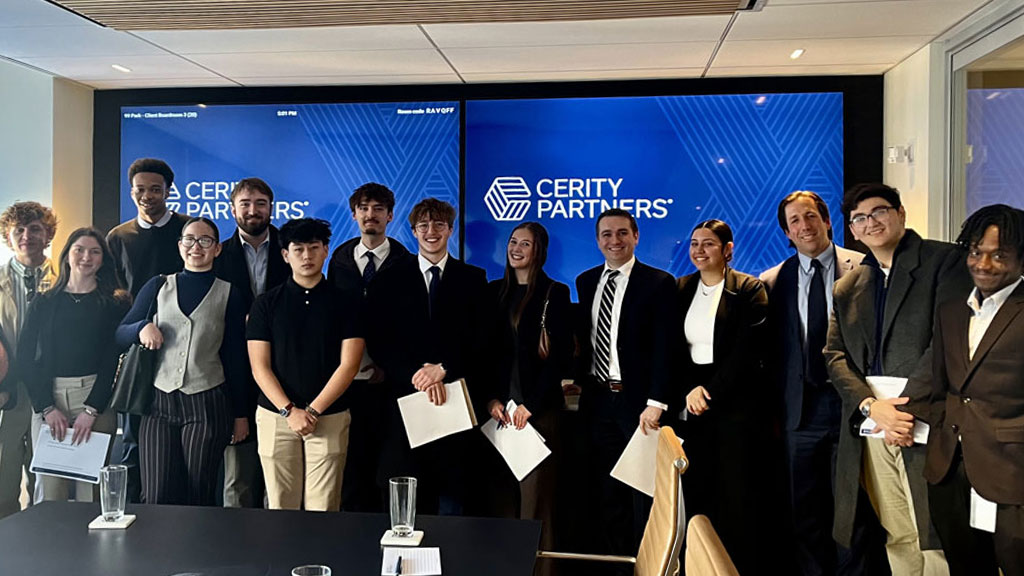
JWU Students visiting Cerity Partners in New York City.
After visiting Cerity, the rest of the evening was open. A few of us had arranged a dinner with Kent Ralph of EY (formerly Ernst & Young), one of the Big Four accounting firms. Hearing about his career path was both relatable and motivating. Like students at JWU, he studied at a non‑target school (target schools are colleges where top investment firms, like Goldman Sachs, actively recruit, giving students a direct path to competitive finance jobs).
We ended the night with a stop at the famous pizza spot featured in “Spider-Man 2,” Joe's Pizza, and then grabbed a gelato before heading back to the hotel.
What Finance Leaders Are Saying About AI, Markets and Your Future Career.
On day two, we were up at 6am to make sure we could get good seats for the opening remarks and keynote sessions at the Forum.
The day was packed with incredibly insightful discussions. The first panel of speakers included Holly Raider, the dean of the Quinnipiac School of Business, Lindsay Hans, the president and co-head of Merrill Wealth Management, and Zachary Buchwald, chairman and CEO at Russel Investments.
We also heard from leaders at J.P. Morgan and other major firms who shared perspectives on the current market environment, the growing influence of AI and the future of the financial industry.
Another panel included Julia La Roche, finance journalist, podcaster and YouTube host of the “Julia La Roche show”; David Kelly, chief global strategist and head of the global market insights strategy team for J.P. Morgan Asset Management; Kristina Hooper, chief market strategist at Man Group; and Lauren Goodwin, chief market strategist at New York Life Investments. The conversation focused on geopolitical uncertainty, the future of the Federal Reserve and where the economy may be heading. At least one panelist believes a mild recession will come based on current market conditions.
The next group of panelists brought together Tom Keene, managing editor for Bloomberg Television & Radio and co-host of “Surveillance” on Bloomberg Radio; Matthew Luzzetti, chief U.S. economist at Deutsche Bank; Dana M. Peterson, chief economist at The Conference Board; and Berlina Uruci, chief U.S. economist and vice president at T. Rowe Price Group. They gave their views on the early stages of the students’ careers and the early years of their own careers — a perspective that resonated with the students in the room. On private credit, the panelists pushed back on the idea that it signals broader market instability, and noted it has always been a cyclical part of finance and how it's always come and gone and isn't something we should worry about. On the topic of AI, their take was more optimistic than alarming: they see it as a tool that will make existing jobs more efficient and will create new ones, rather than a force that will eliminate most careers.
In between some of the panels, we had 30-minute breaks for networking that were great opportunities for interesting conversations with other students.
After the sessions wrapped up, we explored the city and had time to get to know each other better. We visited Wall Street for the first time. Seeing the New York Stock Exchange building in person — knowing how much history and significance is tied to it — was surreal. We ended the night in Chinatown with some great food and even better conversation.
View this post on Instagram
JWU Students Compete in a National Student Portfolio Competition
On day three, after the last panel of speakers — with topics tailored towards individual interests such as career paths, AI and data analytics, women in finance, investment banking and more — it was competition time. Brandon Durante ’28, president of WIFI, and Peña represented JWU in the student portfolio competition.
“Each student team created a poster featuring the analytics of its portfolio performance, top gainers and ratios that compare their funds to their benchmarks and other information such as the investment strategy used,” explained Peña.
“Students from across the country displayed their posters and had the opportunity to connect with other students, exchange ideas and hear different perspectives on market trends. When the competition began, it was nerve-wracking but exciting,” described Peña.
“We had one minute to talk about the fund to two of the judges and also had to answer a question from them, ‘What is the biggest challenge you face?’ We answered, ‘the lack of access to international Markets,’” said Peña. “Although we didn’t win, the experience was unforgettable and we walked away with new insights, connections and a deeper appreciation for the industry.”
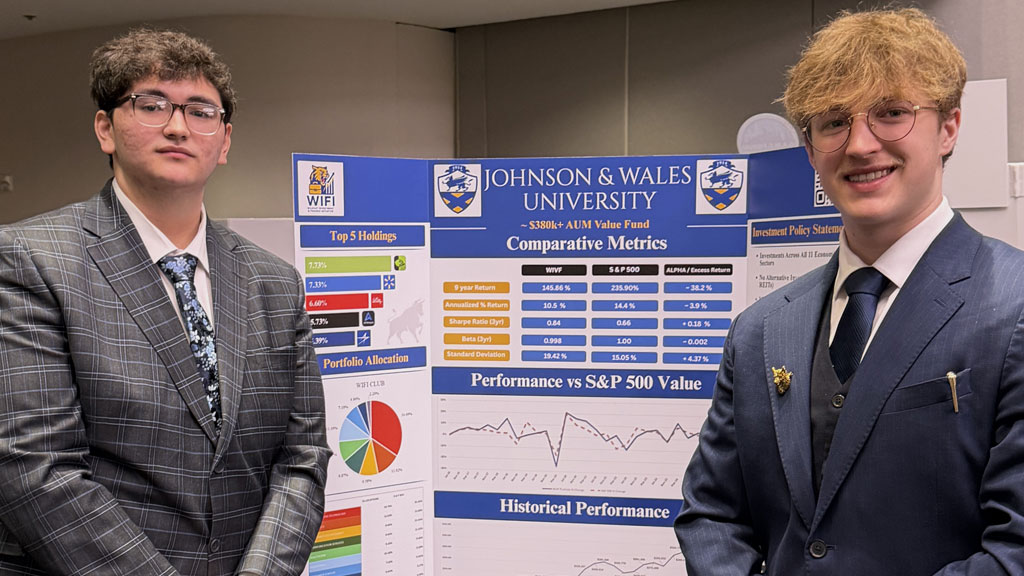
Oscar Peña and Brandon Durante ’28 with poster for competition.
Takeaways from the GAME Forum
Attending the GAME Forum was more than just a conference; it was a hands-on learning experience that brought classroom concepts to life. From hearing directly from industry leaders to networking with students from other universities, every moment offered something meaningful. The trip reinforced why opportunities like this matter for students: they expand your perspective, strengthen your confidence and help you envision the kind of professional you want to become.
View this post on Instagram
Related Posts

Culinary
Alumni
Hospitality & Business
How 3 JWU Alumni Helped Run FIFA World Cup 2026
Experiential Education
Arts & Sciences
What Does a Cybersecurity Internship at JWU Look Like?
Alumni
Hospitality & Business
From JWU Student to Restaurant Owner: Andrea Cabrera
Related Posts
Hospitality & Business
Experiential Education
Students
JWU Hospitality Student Lands Outdoor Adventure Internship
Culinary
Alumni
Hospitality & Business
How 3 JWU Alumni Helped Run FIFA World Cup 2026
Experiential Education
Arts & Sciences
What Does a Cybersecurity Internship at JWU Look Like?
Alumni
Hospitality & Business