News
Arts & Sciences
Health & Wellness
Arts & Sciences
Cultural Life Series 2026: Why Preserving History Matters
As the United States approaches its 250th anniversary, JWU’s Cultural Life Series hosted a conversation on who preserves history and why it matters. Drawing on Rhode Island’s past and the broader American experience, the discussion explored how culture, power and perspective shape the stories that endure.
Presented through the generosity of JWU Trustee Robert J. Palleschi ’86, ’14 Hon. and the Palleschi Family Endowed Fund, the panel featured Bill Bartholomew, a Providence-based journalist, musician and host of Bartholomewtown, known for his conversations on politics, policy and culture, and C. Morgan Grefe, Ph.D., executive director of the Rhode Island Historical Society and historian specializing in U.S. social, cultural and public history.
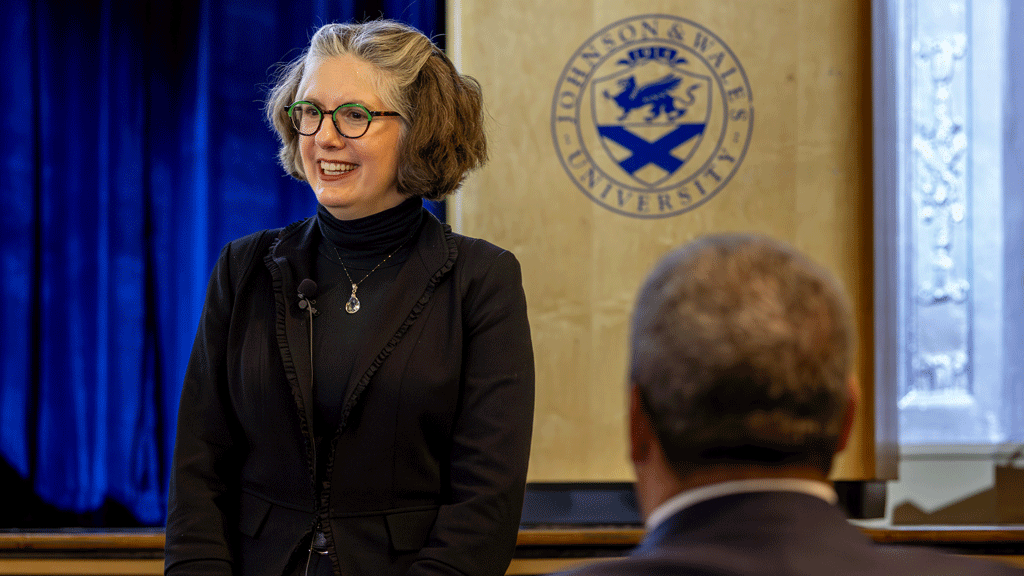
Professor Ken Schneyer, JD, kicked off the panel by introducing Rhode Island Secretary of State Gregg Amore, who acknowledged Johnson & Wales University’s importance in the state’s economy and culture. As the chair of the RI250 commission, Amore oversees the commemoration of events that influenced the ideas of freedom, equality and independence of Rhode Island in relation to United States. Before introducing Bartholomew and Grefe, he summarized RI250’s focus: “We will celebrate the second sentence of the Declaration of Independence: that all are created equal and born with inalienable rights.”
“If we take away history education, we erode the ability to make sound judgments.”
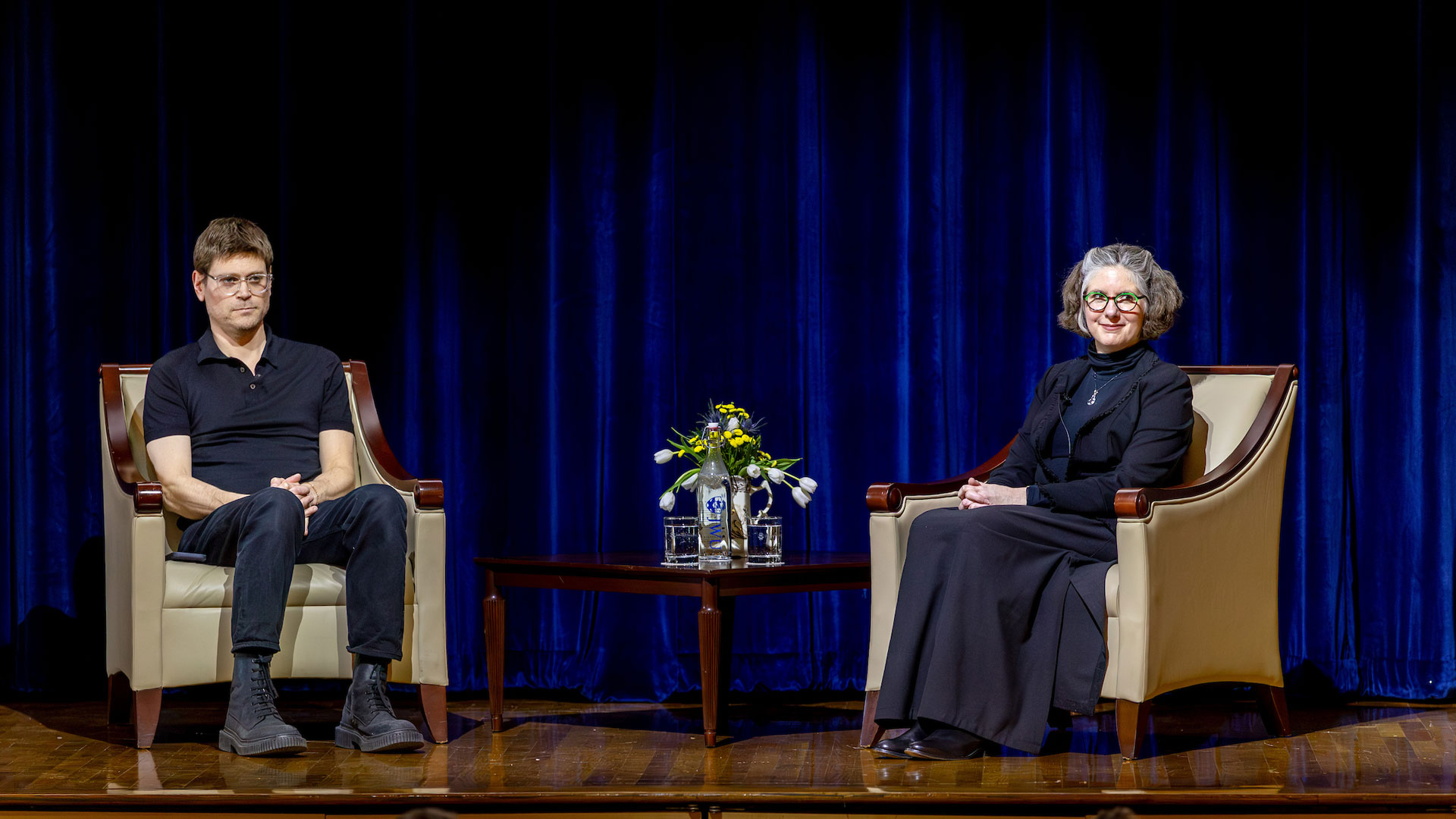
How do we make sense of history?
Grefe recommends analyzing a collection of documents to try to understand the full story — the choices and actions that individuals made in tumultuous times. She suggests visiting institutional libraries with vast online resources, such as the Library of Congress and the National Archives, to research more broadly and then explore areas of interest more in-depth. For instance, local organizations and ethnic groups might have church records and cultural items that add nuance to the overall picture.
“There is interpretation and then there is opinion — and those are different things,” she explains. Through analysis and agreement of transpired events, scholars can craft reasonable arguments. This shared basis in evidence is very different from opinion. “We know the contours of [factual events], but not the day-to-day except small snapshots that were able to be saved,” she continues. “We also must realize who has access to paper, the time required to keep a record, the stability to save these things over time. Some of it is just luck. If we have one example of something, it is not enough to make a definitive statement. We need to dive into different stories and voices — work with the records of native nations, which complicates the narratives and gives them a different perspective.”
Students of history must be able to discern trusted sources and understand the role of individual actors to avoid dire consequences. “If we take away history education, we erode the ability to make sound judgments,” she continues. “If we don’t understand what people did before and the consequence of these things, we make poor decisions.”
View this post on Instagram
How do we hear all sides of the story?
Listening to Rhode Island’s native tribes and experts’ understanding of events is how another side of the story is told. Rhode Islanders once relied on natives to teach them how to farm the landscape during a mini-Ice Age. But the subsequent War for New England, also known as King Philip’s War, was the bloodiest and deadliest war on American soil, impacting towns and native nations. It forever changed the dynamics and any semblance of trust that had been developing.
Grefe notes a common misconception: Puritans did not come to Massachusetts for religious freedom — they came to worship as they wanted without punishment. That’s different than giving OTHERS the right to worship as they wanted. Puritans banished those who did not conform, including Roger Williams, the founder of Rhode Island who advocated for separation of church and state, and Anne Hutchinson.
What makes Rhode Island unique?
Roger Williams mandated that his colony’s residents (including women) be able to choose for themselves how they worship. Bartholomew says this freedom is key to understanding the Rhode Island zeitgeist. “Being an outsider and having independent thought is embedded in the Rhode Island charter, which laid out self-governance in ways that other colonies didn't have,” he says.
Rhode Island’s 1663 charter was expansive in terms of 17th century thought — so expansive that it was used as the state constitution until 1842. Since Rhode Island couldn't compete with the size and scale of Connecticut and Massachusetts, it competed as an economic engine through its lack of an official religion; capital that other colonies would have required for church tithes was instead invested to help Rhode Island businesses grow, leading to speculation in the West Indies and slave trade.
From how to worship to what to do with their money, Rhode Islanders have never liked being told what to do. Their concern over taxation, cargo and freight led to revenue disputes, including the most famous in state history: the Gaspee, the first violent uprising against Crown authority in British North America, preceding the Boston Tea Party by more than a year.
Grefe believes that the Rhode Island concept of religious toleration and the separation of church and state are ”fundamentally important in understanding our republic. The reasons behind Roger Williams’ actions and the evolution of the separation of church and state concept are something that, one, I think Rhode Island deserves more attention for, but two, I think, is a point which should be continually celebrated, understood and reinvented.”
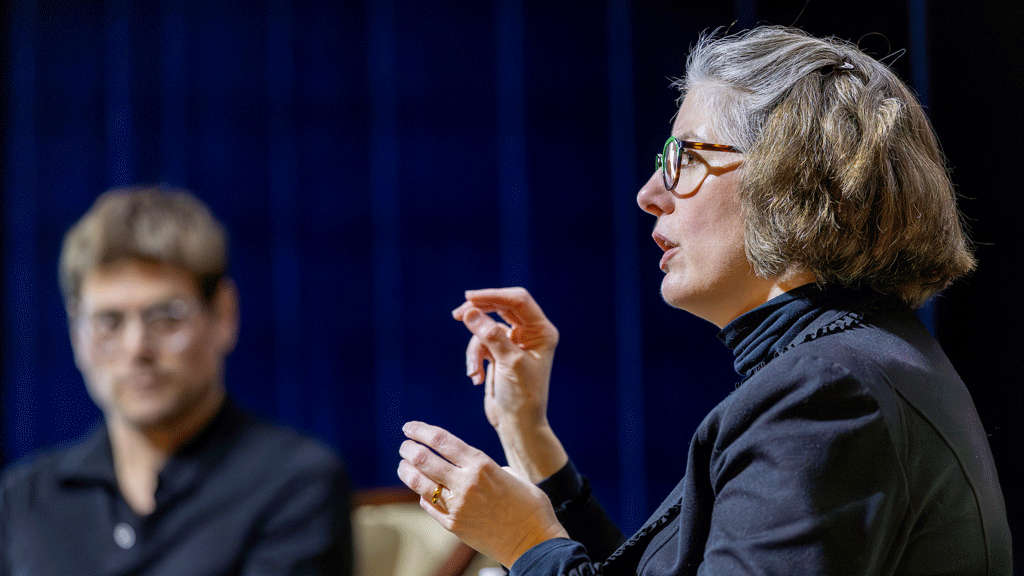
With such an inundation of content, how can future historians discern fact from opinion?
Digitization has given scholars a gift: broader sample sizes and clues about stories we never realized before that lead to new stories and considerations. AI-aggregated data allows us to see where and how information originated and determine the trustworthiness of sources. Preserved possessions can reveal who made them, who they were for, how they were used, and what path they took to get here. “Everyday items give a glimpse into the lives of countless people,” Grefe explains. “Not the people who wrote written records, but the people who got up in the morning and made choices, made something beautiful that is still here. It is a gift to live in this community, to be inspired and informed by past but look toward the future.”
What does the future hold?
With the current political climate, Bartholomew wonders if there will be a national compact of how to celebrate the 250th anniversary — or if the United States will even have 300th. Grefe recalls how disorganized the bicentennial celebration was, yet today is remembered fondly. People who experienced those events chose to frame them as a success.
“If you as a student are hearing a discussion like this, you can tell that story,” Bartholomew adds. “You could be the one who shapes history in how you tell it. That’s a very powerful thing that all of us have access to.”
When a student asks about the butterfly effect — how minor, seemingly insignificant events can lead to massive, unpredictable and long-term consequences — Grefe grows reflective.
“Every day is someone’s best day and someone’s worst day,” she answers. “When Roger Williams decided to come to Rhode Island, he didn't know what the outcome of his choices would be, and neither do we. It’s scary but also empowering that we all make a difference in every choice that we make. It’s a responsibility, but it has unimaginable potential.”
Listen to the Bartholomewtown conversation in full:
Apply to JWU Visit JWU Transfer to JWU

Related Posts
Arts & Sciences
Alumni
New Portrait Honors JWU Founders Gertrude Johnson and Mary Wales

Experiential Education
Arts & Sciences