News
Arts & Sciences
Health & Wellness
Alumni
Arts & Sciences
Industry Pros Share What to Know About AI in the Workplace
Artificial intelligence (AI) has become a prominent part of everyday life. As the abilities and applications continue to expand, AI is now finding its way into nearly every professional industry. Whether you've embraced it or remain skeptical, using AI effectively and ethically is becoming a valuable skill for college students to have as they enter the workforce.
JWU is becoming a key player in shaping the future of AI in higher education by partnering with the American Association of Colleges & Universities’ Institute on AI, Pedagogy and the Curriculum. “Through our engagement with the AI Institute, JWU is contributing to a broader national conversation about AI in higher education, helping ensure that both educators and students are prepared to navigate the opportunities and challenges of an increasingly AI-driven future,” shared Frank Tweedie, the executive director of cybersecurity & computer science education at JWU.
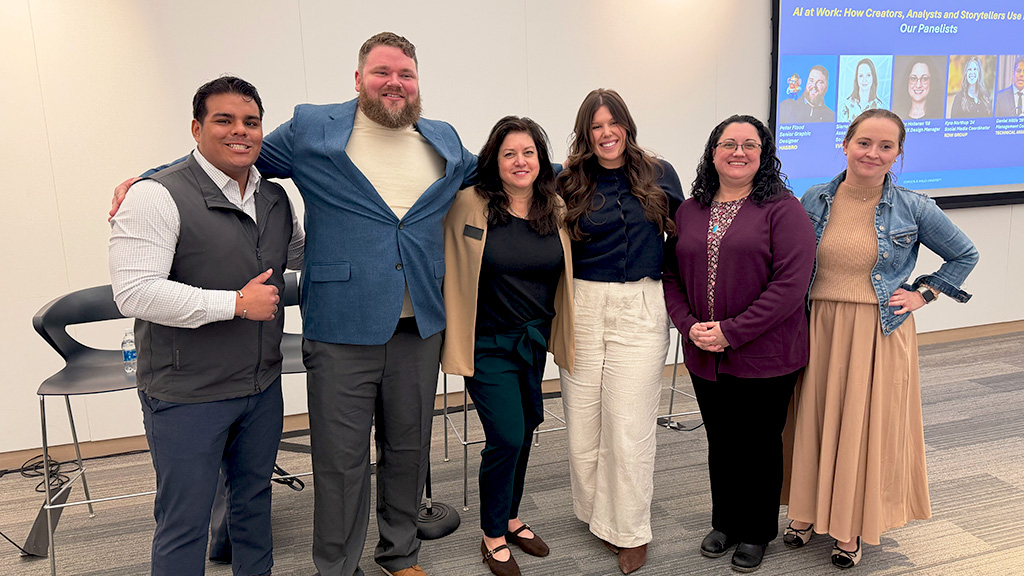
Navigating the AI-driven future is a hot topic of discussion around campus, most recently at a panel discussion featuring five industry professionals (four of whom are JWU alumni) at the Providence Campus.
Moderated by Associate Professor Diane Santurri, M.Ed., the panel featured:
- Peter Flood, senior graphic designer at Hasbro
- Sierra Barter Terry ’09, associate director of social media at Eversana Intouch
- Bethany Holleran ’08, senior ux design manager at Deltek and adjunct professor at JWU
- Kyra Northup ’24, social media coordinator at RDW Group
- Daniel Willis ’20, management consultant at Technical Ascent
They represented a variety of industries and roles and shared their thoughts on AI, how they use it in their work and what college students entering the workforce should know. Here are some of the key takeaways from the conversation.
AI is a Tool, not a Replacement for Humans
Though the panelists use AI differently in their varying roles, they all agreed it should be used as a tool, not something to replace humans.
“We need to be looking at AI as more of a tool or resource versus the end all be all,” said Barter Terry, who studied marketing and communications at JWU. “It can help you expedite and be more efficient, but we still need to make sure that we're thinking critically, have the media literacy to be critical of what we see online and check that it comes from reputable sources.”
“Critical thinking is one of the most important skills you will ever have, and it will keep you employed as this technology landscape shifts,” added Flood.
The panelists revealed they often use AI for things like meeting and email summaries, note taking, building agents to automate small tasks or analyzing large sets of data. They’re using a wide variety of tools such as ChatGPT, Microsoft Copilot, Google Gemini, Claude and others.
“If it's out there, we've probably been allowed to run a pilot and test it out,” said Holleran, who majored in graphic design at JWU. “It's a tool to help you do some of those things that were time consuming, so that you can really focus on the more important aspects of your role, like strategy, then use AI as a thought partner and a tool to help you iterate or create a starting point.”
AI is Already Making an Impact and Changing Industries
Though the panelists agreed that they see AI as a useful tool, they also acknowledged that it has and will continue to change industries.
“I do think it’s changing our role in design a lot right now, and it's in flux,” said Holleran. “It's going to keep changing, but what we are seeing is a blending of the roles and closer collaboration with our product and engineering partners. Some of the coding tools are changing the game in that way. In some cases, it’s really good and positive. In others, there are challenges that come along.”
“One of the most important things to understand about AI is that it is becoming a foundational capability across industries, much like the internet or cloud computing did in previous decades,” said Willis, a JWU business administration graduate. “In the national security space in particular, AI will increasingly shape how governments analyze information, protect supply chains and respond to emerging threats. However, the real impact of AI will not simply come from the technology itself but from how organizations responsibly integrate it into decision-making processes.”
View this post on Instagram
“It isn’t going away, so it’s essential to find ways to integrate it into your workflow or you are going to fall behind your competitors,” added Northup, who studied advertising and marketing at JWU Providence. “While some worry that AI could replace jobs — and that may happen in certain industries — at my agency, we view it as a tool to enhance human work. The key is to ensure humans remain at the forefront of AI’s power, using it to work more efficiently and gain deeper insights rather than letting it take over our creativity or expertise.”
For Young Professionals, AI Prompt Engineering is a Key Skill
Most college students are already using AI in their daily life, but for professional use, they need to know how to use it effectively.
“Prompt engineering is probably the most important thing to know how to do,” Northup said. “You can ask ChatGPT anything or say ‘rewrite this caption’ which is awesome, but if it doesn't have a prompt of what the personality is supposed to be, the tone or what the brand is supposed to be, it's not going to get something that's really that useful. So, understanding how to prompt the AI to help you and teach it your own thought process is important.”
“You’ve got to get technical, get hands on with it and get some certification while you're in school,” added Willis. “Whether it be Amazon Web Services (AWS), Databricks, Confluent — there's a lot of free technical training out there.”
While panelists advised students to dig in and learn more, they also warned about the importance of maintaining a healthy relationship with AI when the topics of AI burnout and using AI for emotional support were brought up.
“As people say, we need to touch grass,” Barter Terry said. “We still need real-life conversations and community.”
Related Posts

Culinary
Alumni
Hospitality & Business
How 3 JWU Alumni Helped Run FIFA World Cup 2026
Arts & Sciences
Alumni